In an article published in the Awareness Times on 9
February 2011, it was reported that: "The continual
neglect on patients as being demonstrated by health
workers including doctors, nurses, midwives and
specialists, has become a general cause for concern
among the citizens."
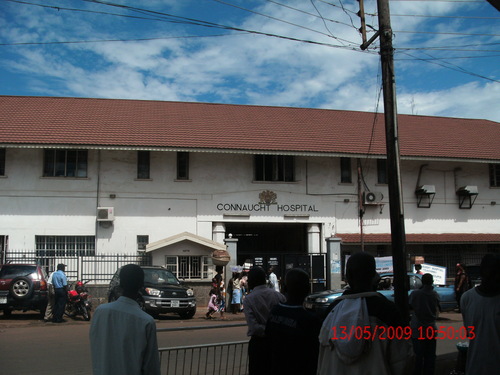
The article further reported that "patients and their
relatives are complaining that despite the over one
hundred percent salary increment paid to health
workers by President Ernest Bai Koroma, in order to
enhance efficiency in health service delivery, the
health workers are still sabotaging the good
intention of the President".
According to the article "the patients consider the
poor treatment meted on them by the health workers
as a total violation of their right to health and
called on the various authorities to intervene and
right the wrongs".
 |
|
Indeed, the people are right to think thus. The
president has during his first term in office taken
steps to improve the health sector in Sierra Leone.
He has increased the salaries of health practitioners
and introduced Free Medical Care for under-fives,
pregnant and lactating women.
These steps have undoubtedly improved the lives of
this group of people. However, little or no firm
actions have been taken against mala fide health
practitioners, whose negligence and indiscipline
have jeopardized the lives of Sierra Leoneans.
|
In the past years we have witnessed pregnant women,
under-fives and lactating women meeting their
untimely death as a result of the arrant negligence
of doctors, nurses and pharmacists. On one occasion
a pregnant woman and her unborn child passed away
because the doctor refused to treat 'them' simply
because he could not work on Sunday.
This insufficient action or inaction by the government
is a violation of not only the people’s right to
health but also to their right to life.
 |
|
Human beings consider their health and
the health of those they care about as a
matter of daily concern. Irrespective of
our age, gender, socio-economic or
ethnic background, "we consider our
health to be our most basic and
essential asset. Ill-health, on the
other hand, can keep us from going to
school or to work, from attending to our
family responsibilities or from
participating fully in the activities of
our community".
No wonder we are willing to make many
sacrifices if only that would guarantee
us and our families a longer and
healthier life. |
The right to health is a "fundamental aspect of our
human rights and of our understanding of life in
dignity". The right to the enjoyment of the highest
attainable standard of physical and mental health
has been recognized in various international human
rights instruments.
It was first articulated in the 1946 Constitution of
the World Health Organization (WHO), whose preamble
defines health as "a state of complete physical,
mental and social well-being and not merely the
absence of disease or infirmity".
The preamble further states that; "the enjoyment of
the highest attainable standard of health is one of
the fundamental rights of every human being without
distinction of race, religion, political belief,
economic or social condition." The 1948 Universal
Declaration of Human Rights also mentioned health as
part of the right to an adequate standard of living.
The right to health was again recognized as a human
right in the 1966 International Covenant on
Economic, Social and Cultural Rights. The Committee
on Economic, Social and Cultural Rights has also
stressed that "States have a core minimum obligation
to ensure the satisfaction of minimum essential
levels of each of the rights under the Covenant.
While these essential levels are, to some extent,
resource-dependent, they should be given priority by
the State in its efforts to realize the rights under
the Covenant."
With respect to the right to health, the Committee has
underlined that States must ensure:
The right of access to health facilities, goods and
services on a non-discriminatory basis, especially
for vulnerable or marginalized groups; access to the
minimum essential food which is nutritionally
adequate and safe; access to shelter, housing and
sanitation and an adequate supply of safe drinking
water; the provision of essential drugs; equitable
distribution of all health facilities, goods and
services.
Moreover, the right to health is recognized, inter
alia, in article the International Convention on the
Elimination of All Forms of Racial Discrimination of
1965, in the Convention on the Elimination of All
Forms of Discrimination against Women of 1979, and
in the Convention on the Rights of the Child of
1989.
Several regional human rights instruments also
recognize the right to health, such as the European
Social Charter of 1961 as revised, the African
Charter on Human and Peoples' Rights of 1981 and the
Additional Protocol to the American Convention on
Human Rights in the Area of Economic, Social and
Cultural Rights of 1988.
In like manner, the right to health has been
proclaimed by the Commission on Human Rights, as
well as in the Vienna Declaration and Programme of
Action of 1993 and other international instruments.
The definition of right to health is not confined to
the right to health care. But it also acknowledges
that the right to health embraces a wide range of
socio-economic factors that promote conditions in
which people can lead a healthy life, and extends to
the underlying determinants of health, such as food
and nutrition, housing, access to safe and potable
water and adequate sanitation, safe and healthy
working conditions, and a healthy environment.
The right to health is not the same as right to be
healthy. According to the General Comment No.14;
"the right to health contains both freedoms and
entitlements. The freedoms include the right to
control one's health and body, including sexual and
reproductive freedom, and the right to be free from
interference, such as the right to be free from
torture, non-consensual medical treatment and
experimentation. By contrast, the entitlements
include the right to a system of health protection
which provides equality of opportunity for people to
enjoy the highest attainable level of health".
According to the Committee on Economic, Social and
Cultural Rights, health care should be available,
accessible (physical and economic), acceptable and
of quality.
Availability: Functioning public health and
health-care facilities, goods and services, as well
as programmes, have to be available in sufficient
quantity within the State party. The availability of
health services that will cater for the majority of
Sierra Leoneans is not there.
Accessibility: Health facilities, goods and
services have to be accessible to everyone without
discrimination, within the jurisdiction of the State
party. Health facilities, goods and services must be
physically and economically accessible.
Physical accessibility means that health facilities,
goods and services must be within safe physical
reach for all sections of the population, especially
vulnerable or marginalized groups, such as ethnic
minorities and indigenous populations, women,
children, adolescents, older persons, persons with
disabilities and persons with HIV/AIDS.
In most parts of Sierra Leone, especially the remotest
parts, there is no physical access to health care.
Pregnant women, children, the invalid and the aged
have to travel long distances before accessing a
health center.
Economic accessibility means health facilities; goods
and services must be affordable for all. Payment for
health care services, as well as services related to
the underlying determinants of health, has to be
based on the principle of equity, ensuring that
these services, whether privately or publicly
provided, are affordable for all, including socially
disadvantaged groups.
Equity demands that poorer households should not be
disproportionately burdened with health expenses as
compared to richer households. In Sierra Leone a
large part of the populace cannot afford good health
care because they are financially strapped.
As well as being culturally acceptable, health
facilities, goods and services must also be
scientifically and medically appropriate and of good
quality. This requires, inter alia, skilled medical
personnel, scientifically approved and unexpired
drugs and hospital equipment, safe and potable
water, and adequate sanitation.
The quality of health facilities, goods and services
in Sierra Leone leaves a lot to wish for. Most of
the health practitioners are not qualified to
perform the duties that they are supposed to carry
out. Furthermore, little efforts have been made to
stop the importation of unsafe drugs. These fake
drugs exacerbate the health hazards that Sierra
Leoneans are facing.
All health facilities, goods and services are
acceptable when they are respectful of medical
ethics and culturally appropriate, i.e. respectful
of the culture of individuals, minorities, peoples
and communities, sensitive to gender and life-cycle
requirements, as well as being designed to respect
confidentiality and improve the health status of
those concerned.
The right to health, like all human rights, imposes
three types or levels of obligations on States
parties: the obligations to respect, protect and
fulfil.
The obligation to protect requires States to take
measures that prevent third parties from interfering
with this right. Under this obligation government
should amongst others ensure that privatization of
the health sector does not constitute a threat to
the availability, accessibility, acceptability and
quality of health facilities, goods and services.
The emergence of the numerous private hospitals in our
country has led to the neglect of patients in
government hospitals where health care is cheaper.
Almost all health practitioners, especially doctors,
have or are attached to a private hospital.
In pursuit of their greedy intentions, they abandon
patients who go to government hospitals, where
health care is completely in the doldrums. Firm
actions should be taken against these greedy health
practitioners who only pursue profit at the expense
of their fellow Sierra Leoneans.
In addition, in order to protect the people’s right to
health, the government should ensure that medical
practitioners and other health professionals meet
appropriate standards of education, skill and
ethical codes of conduct.
To a very large extent the government is not doing
much to achieve this because a large group of the
health practitioners do not do their work properly
as many patients suffer humiliation, neglect and
death.
The obligation to fulfil requires States to adopt
appropriate legislative, administrative, budgetary,
judicial, promotional and other measures towards the
full realization of the right to health. The
obligation to fulfil contains obligations to
facilitate, provide and promote.
 |
|
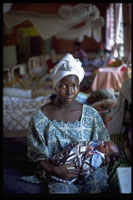
The Free Medical Care for pregnant women, under-fives
and lactating mothers is a very good initiative.
However, due to the insufficient action or inaction
by the government, many health practitioners are
sabotaging this noble intention of the president.
Sierra Leoneans fervently hope that the ratification
of the Sierra Leone Health Service Commission will
help remedy this health malaise that claims a lot of
lives everyday. This Commission should not be
another 'window-dressing' solution to the numerous
problems that we are facing in Sierra Leone.
|
The obligation to respect requires States to refrain
from interfering directly or indirectly with the
enjoyment of the right to health. The obligation to
respect includes the prohibition of marketing of
unsafe drugs.
Sierra Leone is fighting a long battle with importers
of 'fake drugs'. The government is losing this
battle as the country is now replete with unsafe
drugs that are dangerous to the health. Health is a
fundamental human right - indispensable for the
exercise of other human rights. The absence of
respect, protection and fulfilment of the right to
health can impede the enjoyment of the right to
life.
The government should therefore take immediate
action - efficient and effective, to improve the
health of Sierra Leoneans.
Last Friday the right to health was a topic of
discussion on Salone Radio Amsterdam. We were joined
by two guests from London to discuss the health
problems in Sierra Leone. If you want to listen to
the radio programme, you can go to this link:
Part one:
http://www.salto.nl/streamplayer/ondemand_razo.asp?y=11&m=11&d=04&t=2000&s=1800
Part two:
http://www.salto.nl/streamplayer/ondemand_razo.asp?y=11&m=11&d=04&t=2100&s=0
Mohamed Kunowah Kiellow, Amsterdam, The Netherlands
Back to main list of
articles

